
A tributary approach to learning the Colorado River
What does water education look like when knowledge is so distributed?

Hello, and welcome back to Invisible Waters! Popping up from a few deadlines at the end of the month to do a quick dispatch (more to come soon). Mostly I wanted to share a cross-post with the California Water Blog at UC Davis’ Center for Watershed Sciences.
Starting in January this year, I helped facilitate a graduate hydrology seminar at UC Davis on the Colorado River with two incredible collaborators, Kira Waldman and Lindsay Murdoch. Each week, we invited a speaker from the watershed to offer their insights on the basin’s past, present, and as best anyone can guess, future. Facilitating the course brought me back to my reporting roots. One of the best parts about being a journalist is getting to hear from many perspectives and then finding connections and contrasts across different disciplines. It was rewarding to share that with students.
The course was also a important reminder of how distributed and siloed knowledge can be across watersheds, even large transboundary basins like the Colorado River. It was telling that many speakers we invited wanted to sit in on sessions to hear from their colleagues. It underscored the need for water education to embrace what we call “a tributary approach,” and likely the need for more platforms to talk candidly about some of these issues. More in the post below. A big thank you to the California Water Blog for publishing our piece and its editor Christine A. Parisek.
I’ll be back with some news updates next week, but a few stories that caught my attention:
This is a major one for desert groundwater watchers: Trump administration approves Cadiz project in the Mojave, the L.A. Times’ Ian James reports. Last week, Cadiz announced an deal to sell the water to an Arizona water agency.
A $1.5 billion groundwater takings case is going to trial in Las Vegas. More from the Las Vegas Review Journal’s Alan Halaly on what’s at stake. This is a case about fallout from a decision to manage a regional groundwater flow system that discharges to springs, which form the headwaters of the Muddy River, a Colorado River tributary. It’s also a case about prior appropriation. It’s all connected.
Supercharged bubbles are threatening Lake Powell’s dam. Federal officials are battling to sustain water levels, the Colorado Sun’s Shannon Mullane reports.
Arizona cities banked Colorado River water for decades. How much will they be allowed to get back? Interesting piece on uncertainty around the rules for sharing and taking water out of a groundwater bank, KUNC’s Alex Hager reports.
A tributary approach to learning the Colorado River
By Kira J.Z. Waldman, Daniel Rothberg, and Lindsay Murdoch
. . .
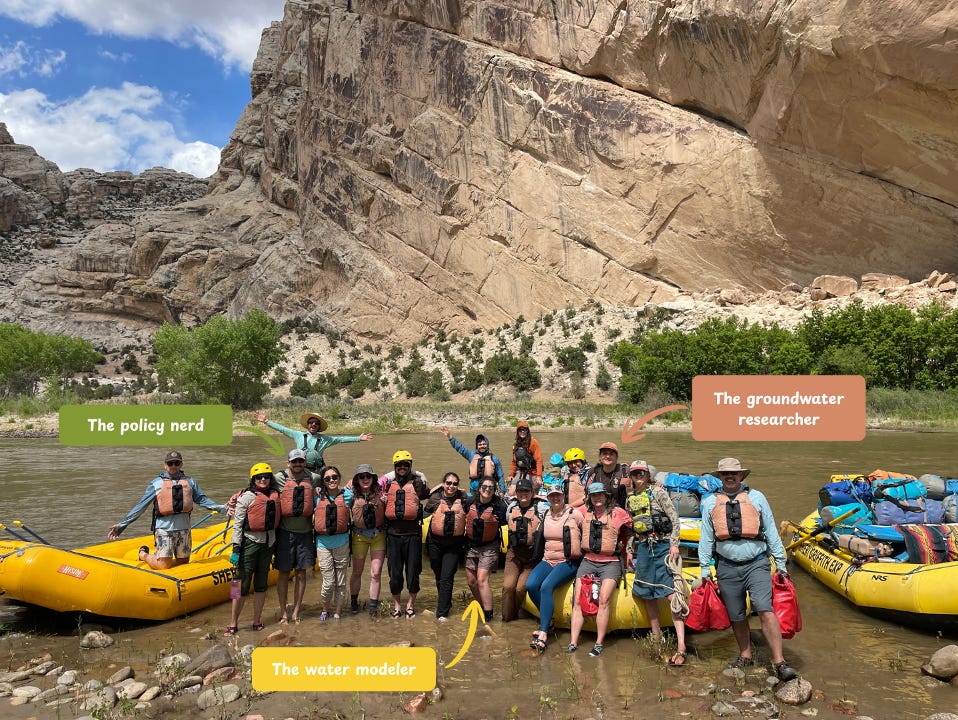
A groundwater researcher, a water modeler, and a policy nerd walk into a gravel bar (on the Yampa River)… and decide to facilitate a seminar (at UC Davis)
. . .
If watersheds are dynamic systems, changing in flow and form over time, understanding them is an exercise in moving between unique perspectives, values, and priorities. Or so we — a groundwater researcher, a water modeler, and a policy nerd — quickly learned when joining other students and professionals on rafts to paddle the Yampa River (Figure 1). This trip was organized as the fourth iteration of the Climate Adaptation Science Academy Experiential Learning Expedition (CASA ELE), a program led by Secure Water Future with the goal of bringing together an interdisciplinary group of researchers studying water in the West. After exploring the Upper Colorado River Basin with a series of site visits, we spent four days rafting one of the West’s few remaining free-flowing rivers: The Yampa. The more miles we paddled, the more we learned, and the more we realized how little we knew. Answers gave way to more questions, which led to more answers, prompting more questions. It was the most motivating headache any of us have ever had.
A tributary is a stream, river, or glacier that feeds into a larger water body, contributing to its overall flow and expanding it through connections and confluences (Langbein et al., 1947). Just as tributaries expand a river’s flow through connection, the more time we spent in the field, the more we came to see how the basin itself is shaped by a convergence of knowledge streams. Each perspective we gained, during site visits and rafting, added volume, direction and complexity. Together, we saw how these physical and informational tributaries helped form the scaffolding that informs the current state of the Basin (Colorado River crisis fails to force deal from states).
When we got off the river, our headaches had turned into heartaches, understanding the crisis facing communities and ecosystems in the Colorado River Basin. Legal rights to use the Colorado River far exceed actual supply, a problem amplified over the past two decades as a changing climate has contributed to significant declines in streamflow. We had more questions than answers, and we wanted to examine them further in the classroom. But in a dynamic, interconnected, and variable setting — with knowledge distributed across the West — how do you undam knowledge to learn about a whole Basin?
Tributaries of knowledge
The Colorado River supplies water to about 40 million people, as well as critical aquatic and terrestrial ecosystems. From its headwaters to the delta, the watershed spans two countries, seven U.S. states and 30 federally-recognized tribal nations (Record of decision for the near-term Colorado River operations supplemental environmental impact statement). The Basin is home to irrigators, water managers, policymakers, lawyers, and researchers across varied geographies that range from the Alpine Rockies to the Sonoran Desert. Although the river is one of the largest in the Southwest, it is a primary example of living with global water scarcity (Madani, K. 2026). No one person or group holds all the answers.
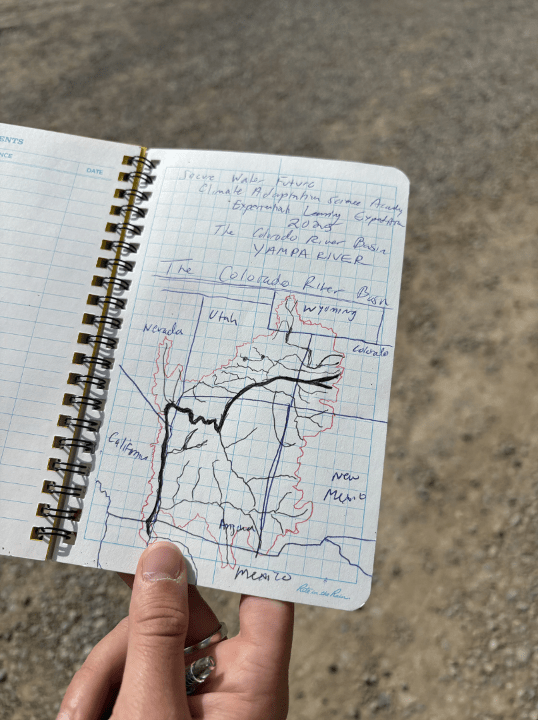
As the new water year began and the fall quarter rolled in, the three of us met for a post-river libation at our usual watering hole in Davis, CA. What started as a casual beer among graduate school friends quickly turned into a deep dive into the unfolding dynamics of the basin and ideas for a graduate seminar. Dunloe Brewery sits over 600 miles northwest of the canal that delivers Colorado River water to farmers in the Imperial Valley at the southern edge of the state. This distance proved irrelevant. Central Valley water management decisions are balanced with expected water from the Colorado River. When there are bad years on the Colorado River, Southern California relies more on deliveries from the Sacramento-San Joaquin Delta, the same water used for our beer. When there are good years in Northern California, Southern California can leave water in the Colorado River system, bolstering regional resilience (When the Delta is stable, the Colorado River is stronger). We nursed our motivation-fueled headaches the following morning — residual from both the Yampa’s questions and the night before — by opening a Google Doc titled Colorado River at a Crossroads: Graduate Student Seminar. Rather than trying to answer these questions ourselves, we wanted to build a space where we might expand, discuss, and complicate what we ourselves were still processing by moving across the basin’s many knowledge tributaries.
When our class of 18 students met in January 2026, the Colorado River Basin was facing an emergency and a looming deadline. Over the past two decades, the Colorado River has seen record-low hydrology and total basin reservoir storage (Schmidt et al., 2023). As the snowpack worsened over the course of the winter, projections for inflow into Lake Powell neared record lows. At the same time, the existing rules for balancing the river’s many reservoirs are set to expire at the end of the year, and the river’s top negotiators were deadlocked on a consensus-based agreement. When we met for our weekly two-hour seminar, there were always new developments to discuss before our guest speakers arrived on Zoom to give us an hour-long presentation on their information tributary. When our speakers arrived, more often than not, they posed as many questions as they had answers. We were all learning in real-time, even the experts.
Bringing the river to the classroom
Speaker selection intentionally emphasized disciplinary, demographic, and geographic diversity, reflecting the complexity of the system itself. As the quarter progressed, contributions accumulated, converged, and often conflicted, mirroring the depth and complexity of the system we were piecing together. In this way, students moved downriver through an evolving watershed of perspectives that expanded the size and order of our shared “river” of knowledge.
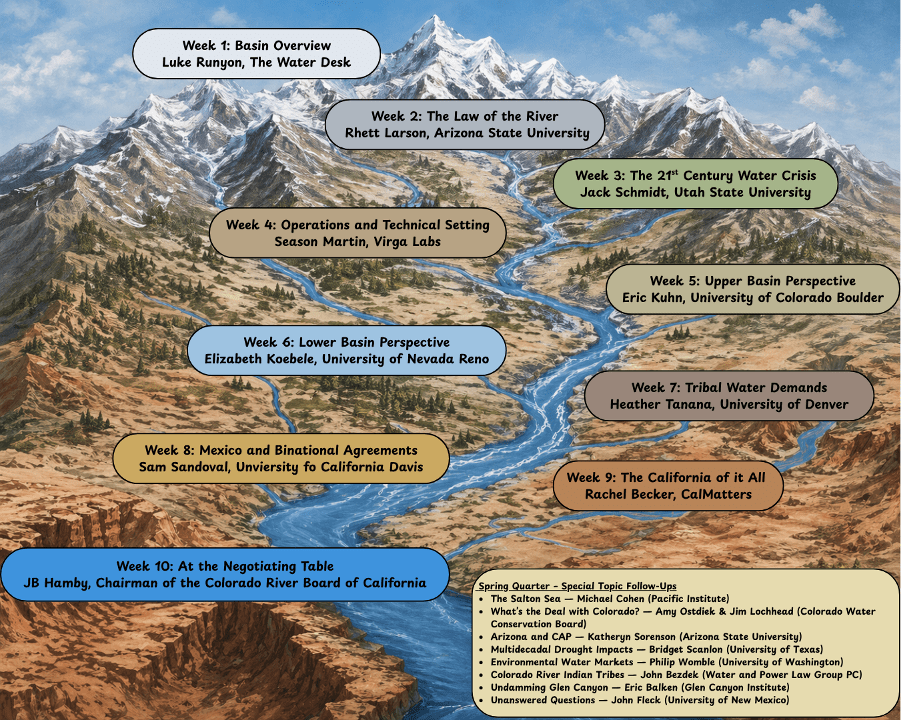
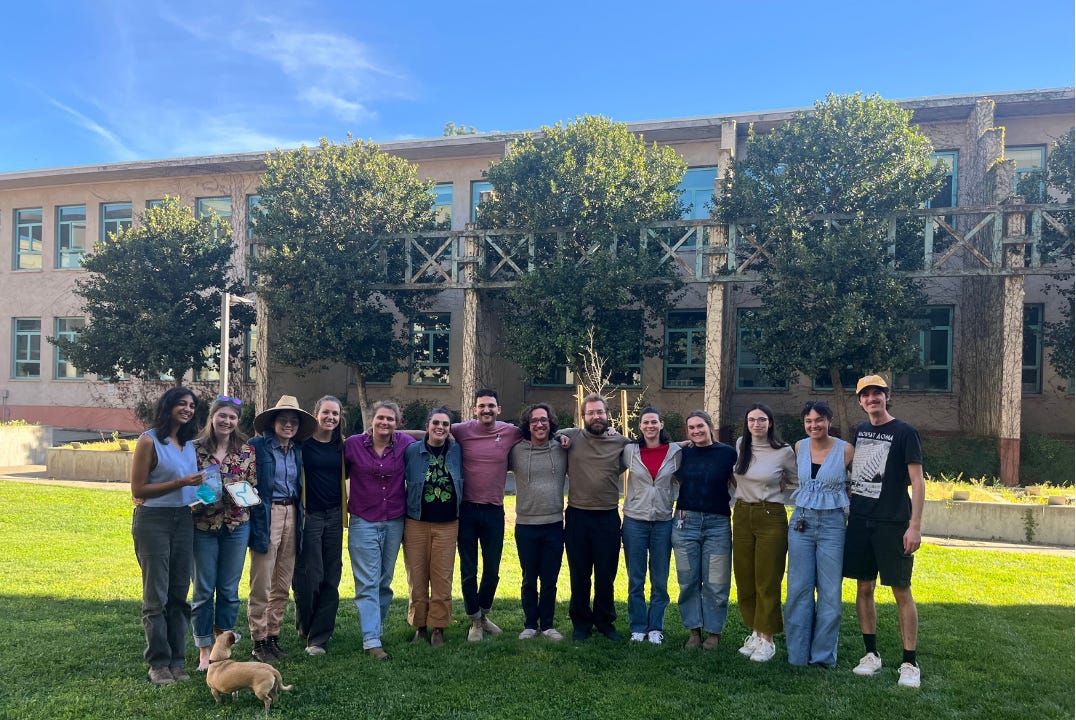
Our seminar brought together students with varied experiences, from hydrology to road ecology. Some knew a lot about the Colorado River. Some knew very little. We encouraged students to apply their own expertise to grapple with the future of the Colorado River — and what it represents for our region — alongside us. Together we asked:
How do Colorado River negotiations reflect broader water access challenges?
How can systems thinking be applied to integrate diverse, and often competing, perspectives from differently-situated communities, balancing contemporary needs and values with historical commitments that dictate water allocations?
How does inclusion affect outcomes in fights over water? What does equity and fairness look like in a water system where significant cuts are required?
To engage these questions, the course pulled in diverse perspectives that emboldened students to probe deeply and challenge ideas. Students moved beyond understanding concepts in isolation and considered how their knowledge could be used, how it could inform questions in future classes, shape perspectives, and guide engagement. Over time, knowledge shifted from something to absorb to something to wrestle with, as the class revisited ideas, analyzed contradictions, and refined our thinking through discussion and reflection.
This transformation was most visible toward the end of the course, when students moved from absorbing to engaging critically, culminating in a 50-minute Q&A conversation with JB Hamby, Chairman of the Colorado River Board of California and the state’s Colorado River Commissioner. As the state’s top negotiator, Hamby is charged with representing California’s position in closed-door interstate talks over how to share the river. Students came prepared and facilitated the discussion, confidently asking tough questions that challenged assumptions and scrutinized status-quo governance. In other words, they held their own at the table.
Asking better questions
At the same time, the process revealed its own limitations. While certain perspectives grew stronger, particularly those grounded in systems thinking and interdisciplinary exchange, others remained underrepresented, underscoring that even as our collective understanding expanded, it did not yet capture the full breadth of voices and streams and creeks shaping the basin. In this way, the course was not about arriving at answers, but about learning how to navigate a system that rewards continued engagement. With significant interest from students, we decided to extend the seminar into spring quarter, focusing on special topics including the Salton Sea and the proposed undamming of Glen Canyon.
Teaching this course reshaped how we see ourselves as both facilitators and water scholars, less as transmitters of knowledge and more as conveners of perspectives in a fragmented system. Bringing together voices across sectors and geographies made clear how siloed information in the Colorado River Basin can be, and how rare it is to create spaces where those divides are intentionally merged. That realization was echoed by our speakers themselves, many of whom expressed curiosity about one another’s perspectives, highlighting the need for more integrative forums like this one.
The major takeaway was not just understanding the Basin’s physical or legal complexity, but recognizing how complexity is partially produced and sustained through disconnected knowledge systems. Perspectives shifted notably at key inflection points, when moving from foundational hydrology into governance, from Upper to Lower Basin tensions, and especially during discussions of Tribal water rights and binational dynamics. These moments disrupted simplified narratives and forced students to sit with contradiction, revealing that the “story” of the Colorado River is not singular, but negotiated, layered, and evolving. And the story is a bellwether for water futures across the arid and semi-arid West.
About the Authors
Kira J.Z. Waldman – the groundwater researcher
Kira J.Z. Waldman is a PhD Candidate in the Hydrologic Sciences Graduate Group at UC Davis, where she studies groundwater flow and quality, managed aquifer recharge, and the behavior of contaminants under increasingly variable hydrologic conditions. She is passionate about teaching hydrology through place-based, field-centered learning and helping students navigate curiosity, complexity, and purpose in the water world. When Kira is not thinking about groundwater, you can usually find her rafting or hiking along rivers in her beloved home state of California, although, admittedly, even then she somehow still ends up thinking about hyporheic exchange.
Daniel Rothberg – the policy nerd
Daniel Rothberg graduated with an M.S. in Environmental Policy and Management at UC Davis. He is starting a PhD at UC Berkeley in the fall, focused on researching groundwater policy in the West, the role of hydrologic science in decision-making processes, and gaps in water law around equity and access. Prior to graduate school, Daniel worked as an environmental journalist writing for The Nevada Independent and other outlets. Daniel sees stories as a way to better understand our complex world and the many ways that water connects us. He still sends out dispatches about water in a Substack called Invisible Waters.
Lindsay Murdoch – the water modeler
Lindsay Murdoch is a PhD Candidate in Water Resources Engineering and a student researcher at the Center for Watershed Sciences. Her work is application-focused, integrating modeling, planning, and decision support for environmental flow management. Before UC Davis, Lindsay worked as a coordinator for a peer-to-peer learning network for watershed restoration practitioners in the arid West
Further Reading
Colorado River Science Wiki is a collaborative clearinghouse for scientific research, datasets, tools, and syntheses related to Colorado River Basin management, designed to support researchers, decision-makers, and the broader public.
The CASA ELE Yampa crew recently authored a paper on experiential water education and interdisciplinary learning: Cliburn et al. (2026) , Cultivating Collaborative Water Leaders: The Power of Experiential Learning, Journal of the American Water Resources Association. https://doi.org/10.1111/1752-1688.70123
Looking to do a deep dive? “Essential books about the Colorado River” from Big Pivots.
The Colorado River Research Group (featuring many of our excellent speakers!!) is an independent interdisciplinary collaborative, housed at the University of Colorado Boulder School of Law, that regularly publishes papers on topics of basinwide importance.