

First I wanted to plug this masterful new piece on the Rio Grande from Jack Herrera in the Texas Monthly. It’s richly reported and an urgent call about the crisis unfolding through the flows of a river, within a system, and across many boundaries. It’s long but I learned so much from reading this piece and recommend it. My main writing and research experience has been in the Colorado River Basin, but I’ve grown increasingly interested in how the two watersheds connect with each other geopolitically, bound up by a 1944 treaty. As the article puts it, “the treaty did not solve so much as organize the fight over water.” Could that not be said about so many of the 20th Century laws, compacts, and agreements that allocate water today?
As for me, I’ve been catching up on a lot of news, writing, and research the last few weeks. But I wanted to pause to write a bit about Nevada’s lawsuit on the Colorado River + I’ve got some other remainders below. As always, please reach out with story ideas or suggestions. —Daniel
Over the past few years, negotiations over the Colorado River’s new operating rules occurred mostly behind closed doors, with little official record-keeping. But based on the public rhetoric, if you were to make a guess, Nevada would have seemed the least likely state to get the courts involved in the dealmaking.
For years, Nevada’s top Colorado River negotiator has repeated variations of this quote: “Anyone telling you we should pursue the litigation path, all they’re saying is they’re willing to roll the dice on your future, because they’re going to change out seasoned water professionals for nine people with black robes.”
Since the early 2000s, Nevada has earned a reputation for building consensus among water users and pushing a “silver buckshots” approach — one in which distributed conservation actions in communities across the basin add up to something greater. Las Vegas has become a model for taking this approach to conservation in its own backyard, significantly slashing per capita water use, giving it added credibility to bring groups together and urge others to cut. It was “Switzerland” in negotiations.
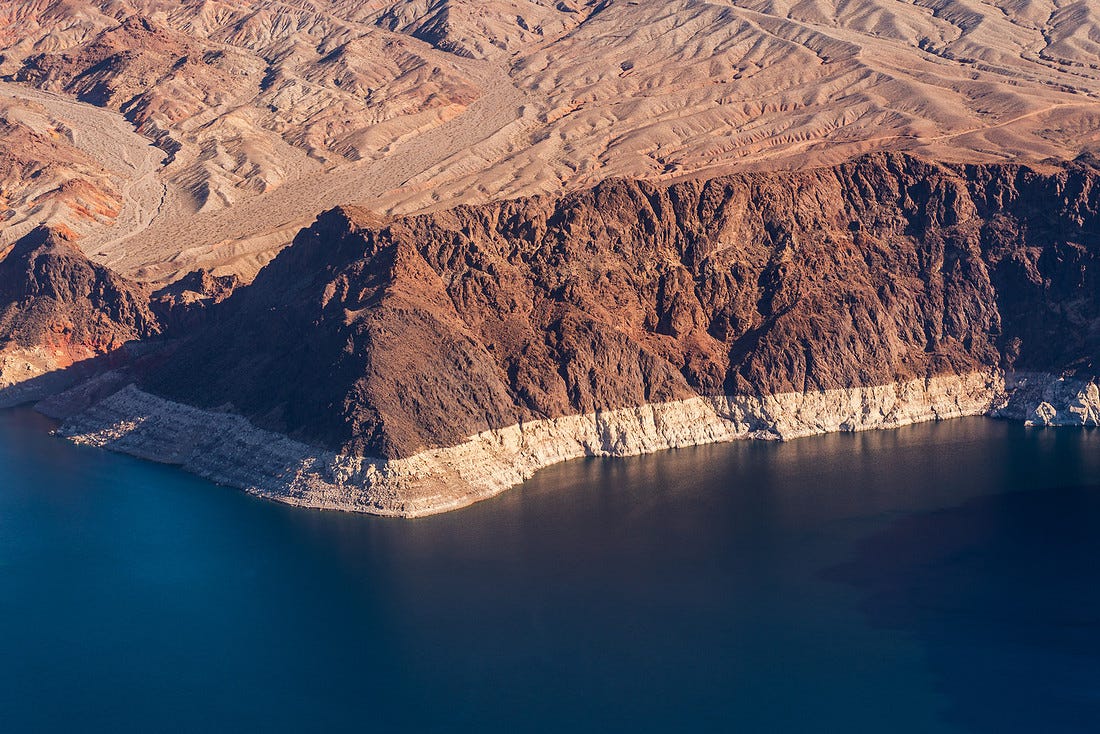
Now Switzerland is suing. After the federal government released a two-year operating plan for the river last month, Nevada wasted no time filing a lawsuit. Alan Halaly, at the Las Vegas Review-Journal, broke the story. Exactly what outcomes the case will lead to is hard to predict, but it marks a rupture in the governance status quo for the river.
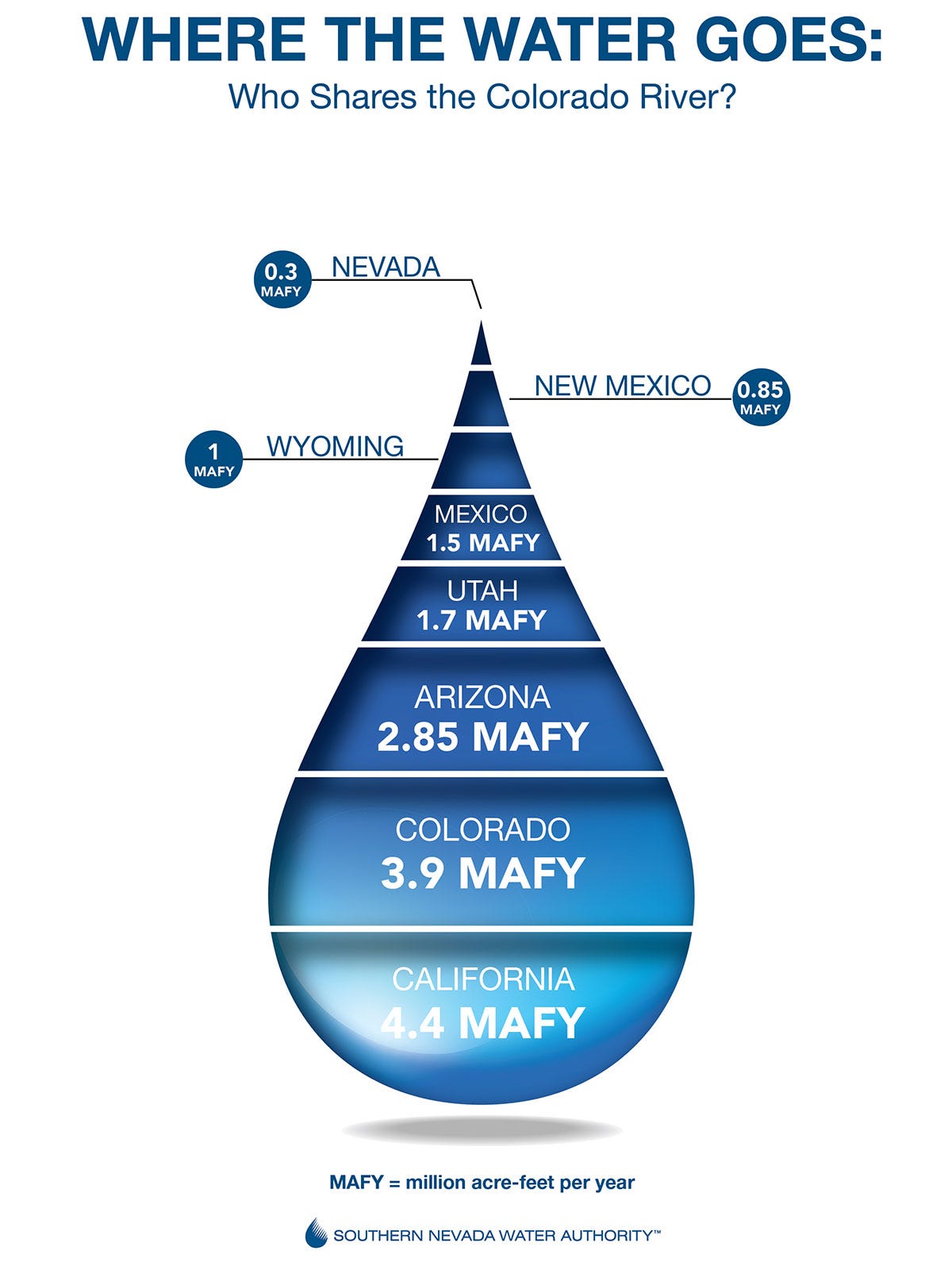
As for why Nevada sued, it’s fairly straightforward. The federal plan, according to the state’s lawsuit, contemplated a scenario in which Nevada’s allocation could be cut by 71%. That would be a crisis. The Las Vegas metro area of roughly 2.5 million people gets 90% of its drinking water from the Colorado River. And such cuts could not be absorbed by turning down less essential uses (like fallowing lawns). There’s not much “extra” water to cut since Las Vegas has already invested in conservation. Cities on the Colorado River, in general, do not account for a majority of total use, but is especially true for Las Vegas, with Nevada having the smallest apportionment of all the states.
Through conservation, Las Vegas consumes less water than it did two decades ago, and not by a small amount. The Southern Nevada Water Authority reports reducing its consumptive use by roughly 40% and per capita use by 58%. These conservation measures rest on implementing many targeted policies (“silver bullets”): removal of decorative turf, lawn conversions, limits on pool sizes, “excessive use” rates, bans on evaporative cooling, and recycling indoor water. Indeed, regional water officials have been so serious about conservation that many of their new regulations have spawned lawsuits accusing the regional water purveyor of exceeding its statutory authority.
With that out there, a few notes on the substance of the lawsuit.
This is a particular kind of Colorado River case. In interstate water conflicts, the U.S. Supreme Court has original jurisdiction, meaning it is the first judicial body to hear a dispute (hence the quote about “nine people with black robes.”) But, as of now, this is not that kind of case. Nevada is still rolling the dice, but not dice are not loaded to land right in front of the Supreme Court. Nevada is suing over a federal agency action, meaning the case starts in Nevada’s federal District Court.
Right now, Nevada is the only state to have challenged the federal decision, but other parties could file lawsuits or seek to intervene, making it a bigger case. This week, the Central Arizona Project authorized litigation if necessary, which could take the form of intervening in Nevada’s case or a separate lawsuit.
The claims largely focus on how the federal government applied two decision-making laws: the National Environmental Policy Act (NEPA) and Administrative Procedure Act (APA) in developing the new operating rules. Nevada alleges the government failed to follow the specific processes laid out in these laws, ignored reasonable alternatives and failed to fully analyze the consequences of its plan (“public health and safety…,” “impacts on Nevada arising from greater reliance on groundwater…,” etc…). These are typical claims stemming from cases involving federal environmental decisions, and federal district court judges in Nevada see them often, given that the U.S. government manages ~85% of the land in the state
However, foundational rules governing the allocation of the Colorado River do matter here too. These rules, known as the Law of the River, represent a century of laws, agreements, statutes, and treaties. Nevada argues, as its first cause of action, that the federal government “failed to interpret and correctly apply the Law of the River,” listing all the places in the new rules obfuscated and hedged.
What happens next is unclear. The uncertainty that comes with a lawsuit could incentivize collaboration and forge a path to a settlement. But it could also lead to conflict and a deeper departure from consensus-based governance (which already has been crumbling) — a reckoning between a centurry-old compact (in its many interpretations), and realities about how risk is distributed and water is used.
That gets back to the point about the status quo. For the past two decades, the seven states that withdraw water from the Colorado River have avoided questions about how existing law allocates the cost of shortages. They’ve done this through voluntary cuts and compromises — with the help of federal funding. The status quo looked reactive, and it largely consisted of the seven-states negotiating on behalf of constituencies outside of the public’s eye. This system was imperfect, historically excluding Tribes at the table. When the state’s agreed, the federal government typically went along. This gave the state negotiators, collectively, immense power — if they could agree. Now we are finding out what happens when negotiations fail and voluntary cuts are not enough. The Colorado River lacks a formal basinwide governance system. Barring the existence of that, was some sort of lawsuit not the inevitable conclusion of failed negotiations all along? As Colorado River expert Doug Kenney pointed out last year, the “governance safety net” — among other safety nets on the river — has been “eroding.”
How information flows: Litigation from one of the “principal” states could also mark a potential shift in how information flows across the Colorado River Basin. The states have liked to keep their discussions vague and outside of the public eye until agreements are close to finalized. The argument for doing so is that it allows for honest dialogue about hard tradeoffs. Litigation, on the other hand, features lots of very public filings that require parties to clearly articulate — then defend — a very specific position. In a lawsuit, everything has to be out there on paper, clear and in the public record. How information flows is probably a subpoint in this post, but it’s an important consideration in a basin with many users, nodes, and levels of governance. It caught my eye back in March that Nevada — one of the entities closest to the Colorado River talks — disclosed in a letter that it had to file a Freedom of Information Act request for records related to Glen Canyon Dam because it had not received the information from the federal government.
Some more reading on the Colorado River:
What the new rules for a shrinking Colorado River mean for tribal nations (High Country News)
On “simple solutions” to the Western water problem (Land Desk w/ thoughtful discussion in the comment section)
Colorado River drought lawsuits may dampen Wyoming dam plans (WyoFile)
“Over our dead bodies” likely response to Arizona proposal to harvest California rivers to fill its water gap (Capitol Media Service)
Clearing out my inbox, notes, etc…
California air regulators will begin tracking and estimating methane generated from the state’s reservoirs. “Researchers have estimated that the waters held behind the world’s dams emit between 10 million and 22 million metric tons of methane per year — roughly equivalent to 3% to 7% of all the methane from human activities.” More from the L.A. Times.
New research found that 20,000 chinook salmon have migrated upstream on the Klamath River since dam removal. But salmon still face barriers to recovery from remaining dams and drought. Excellent Inside Climate News piece on conditions for recovery, including a discussion of a recent 9th U.S. Circuit Court of Appeals affirming that the federal water managers must comply with the Endangered Species Act when operating irrigation infrastructure upstream.
From SJV News on restoring funding for California’s safe drinking water program: “A proposal to fund a state drinking water program that has been a lifeline for communities in the San Joaquin Valley at $171 million passed by the Legislature Tuesday after a harrowing few days and now awaits Gov. Gavin Newsom’s signature… there are still 1,052 failing or at risk water systems statewide that need money to make sure people are getting safe water, according to nonprofit Community Water Center.”
What I’m reading from the data center corner (working on something about this):
Northern Nevada tribes speak out against data centers, from KUNR: “As more and more data centers get approved in the upper Truckee River — especially in Storey County — my big question is ‘where is that water coming from and how is that going to impact the endangered and threatened fish species that are within the lake?’”
Fact check: Is Sam Altman right that almonds use more water than ChatGPT queries? from CalMatters: “The problem, experts say, is that it’s impossible to verify those numbers given what’s public about the secretive industry.”
More than half of Texas data centers broke law by not responding to water use inquiry, from The Dallas Morning News.
Good piece. I would note that the diagram, the big water drop showing water "use" of the states is what they are allocated by the Compact, not the actual consumptive use. Colorado and the Upper Basin states use about half of their allocation. The Lower Basin has had to cut back quite a bit, but historicaly have tended to use all of their allotment, and more.
"Now Switzerland is suing"
When the actor with the most to lose from litigation decides it's the better bet anyway, that's a signal the governance structure didn't just strain, it broke...