
'There's no manual'
Uncharted waters heading into this summer.

“We have no precedent to follow. There’s no manual, there’s no video,” Corpus Christi City Manager Peter Zanoni told the City Council…” — Inside Climate News, 4/23/26
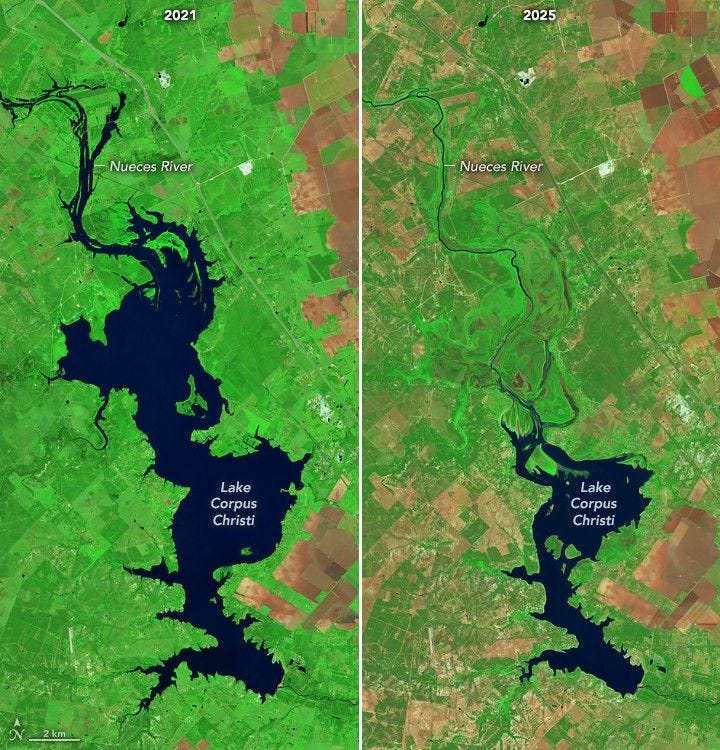
Over the past few weeks, I’ve been watching the news out of Corpus Christi in South Texas (the state’s eighth largest metro area), where years of extreme drought have left combined storage in the main reservoirs at under 8% of capacity. The city, which serves water to about 318,000 residents, petrochemical plants, and nearby towns, is months away from declaring an emergency and cutting water 25% across the board, with implications for households (already under tight restrictions and banned from watering lawns), schools, hospitals, and the economy.
There are many questions about how these curtailments would be enforced. Local reporters for Inside Climate News and the Texas Tribune have helped unravel the story, the decisions that led to the crisis, and the scramble to quickly bring on new supply, including with a private desalinization plant and groundwater pumping that would mine aquifers far in excess of what is considered a safe yield.
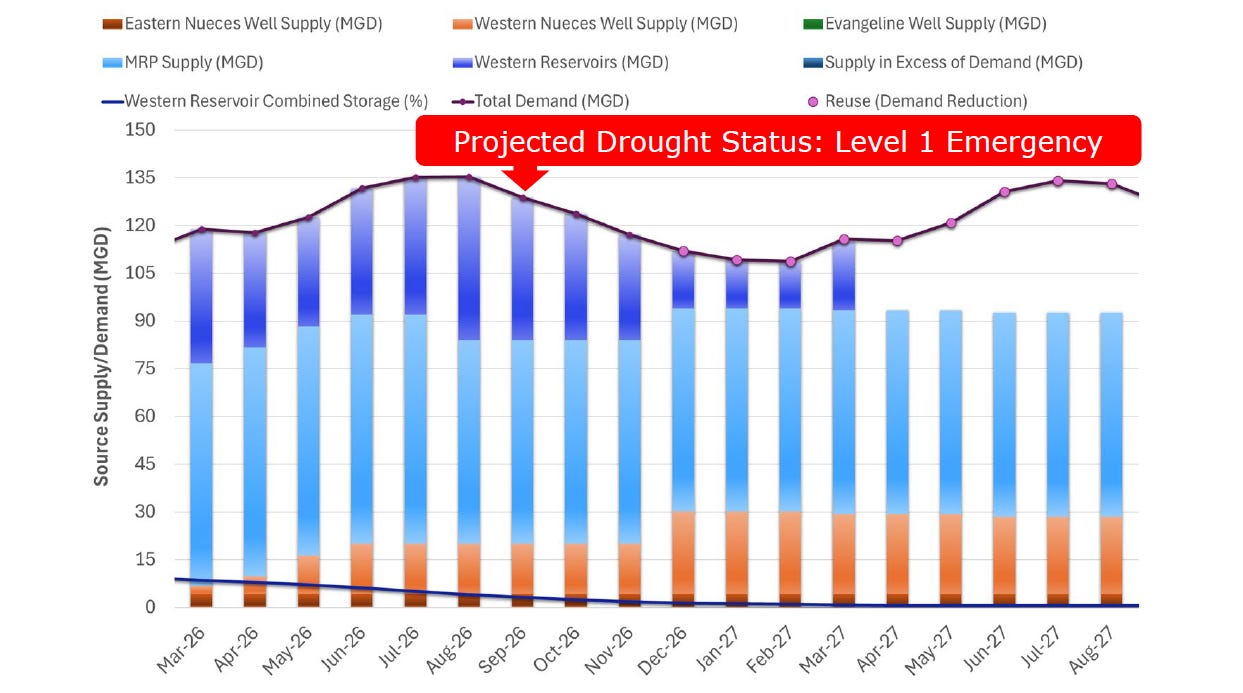
Without any rain and assuming an increase in groundwater pumping and reduced demand due to reclaimed reuse, the city forecasts a gap between total water use (the blue line) and supply shown in the bar charts, beginning around April of next year.
It’s a story, as Grist notes, that may offer a cautionary look into the future. And it’s also one about past decisions and present water stress, water planning and priorities in a crisis: The cost of finding new water supplies, investing in infrastructure, and whose use is safeguarded first when there is no longer enough supply to go around.
To that final point, industrial facilities like plastics plants and refineries account for more than half of the demand. They will be subject to a curtailment under a water emergency, but how cuts are distributed and who pays will be important to watch.
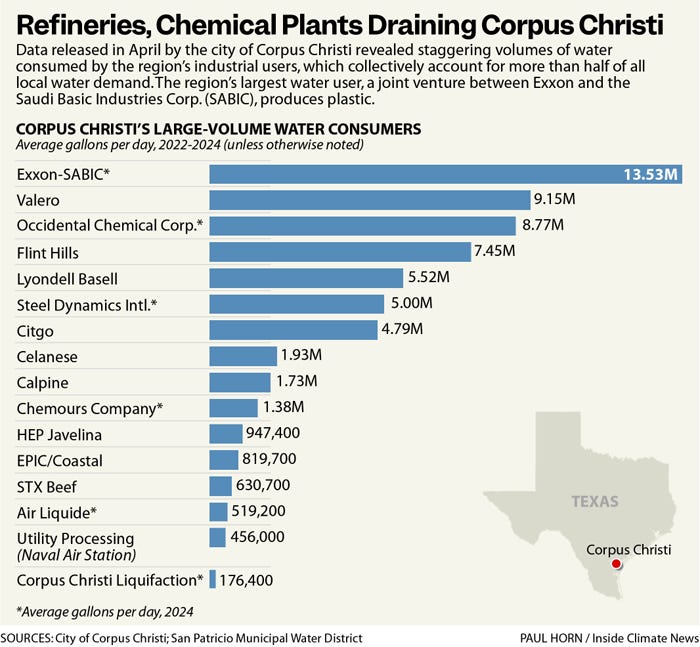
“The city needs to tell industry: we need to give our people water,” one resident told the Texas Tribune in March. “They’re getting water first, and we’re second.”
Movement on the Colorado River
A few updates on the Colorado River since I last wrote.
The federal government said it would release storage water to keep Lake Powell above safe operating levels, offering short-term relief but hardly a long-term fix.
States in the Upper Colorado River Basin (Colorado, New Mexico, Utah, and Wyoming) proposed hiring a mediator to breath new life into deadlocked negotiations to reach a consensus deal on sharing shortages.
The Lower Colorado River Basin states (Arizona, California and Nevada) released a short-term water-savings plan to reduce use; The plan builds and expands upon existing conservation programs, while seeking federal funding to pay for the cuts.
Earlier this week, the federal government floated $450 million for the plan.
Finally, the hydrologic reality.
Experts have been drawing comparisons between this year and 2002, when the river saw record low streamflow. The Water Desk at CU Boulder has an excellent piece on this. But as one of those experts, Eric Kuhn, notes in the story, “the biggest issue is that Lake Powell and Lake Mead were relatively full in 2002.” Today they are not.
I wanted to visualize just how much reservoir storage has changed and (in an effort to sharpen my R skills), I made a couple of charts using U.S. Bureau of Reclamation data using surface storage in the system’s two main reservoirs, lakes Mead and Powell.1
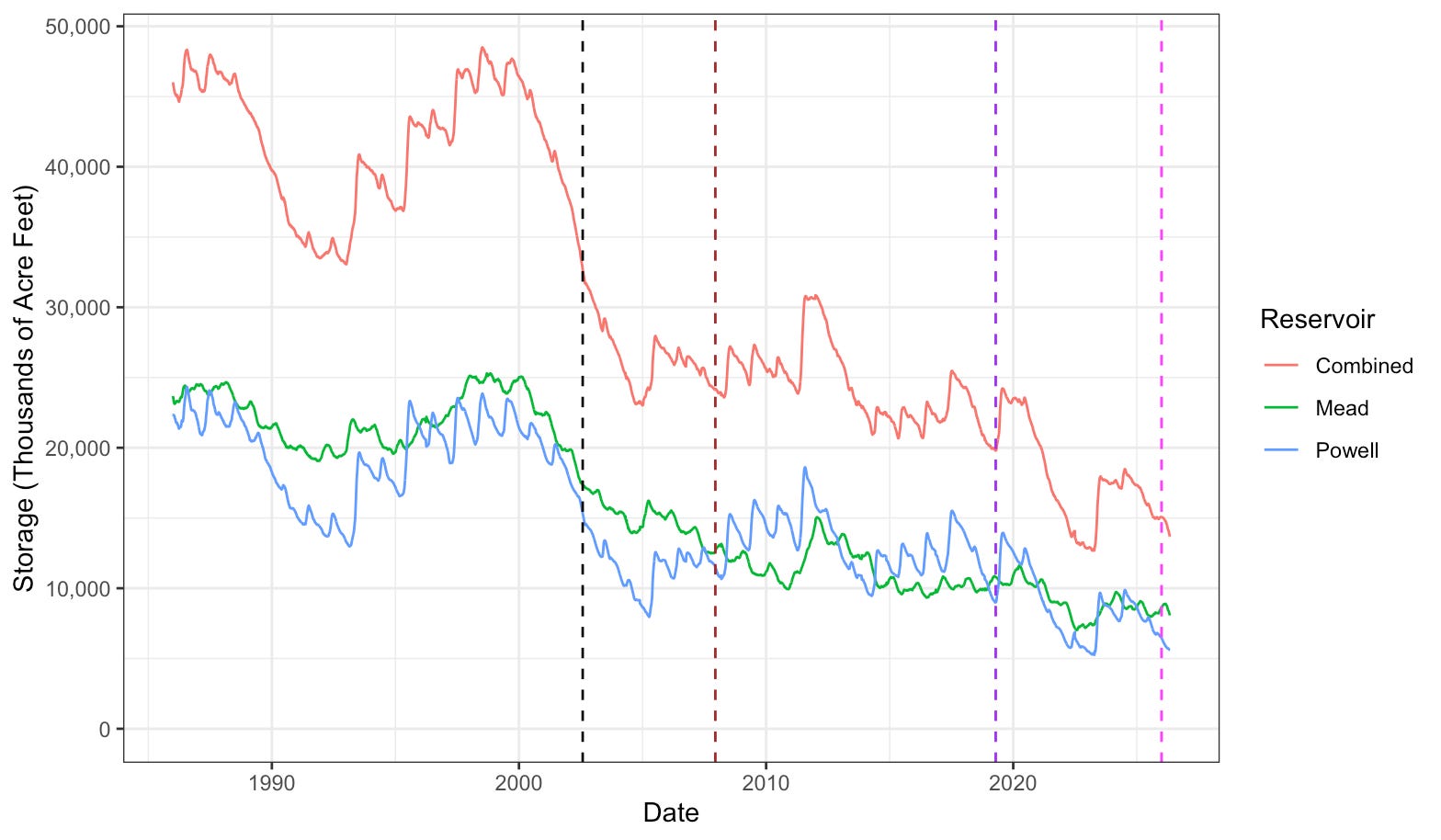
There’s little buffer in the system, little storage to pull from, and there is little coming in, with a recent streamflow forecast for April-July into Lake Powell at 13% of average for 1991-2020, a period that already includes 2002 and the two-decade drought.
In the words of Brad Udall, a senior climate scientist at Colorado State University’s Colorado Water Center, “it’s really grim. It’s horrific. The impacts are going to be everywhere, throughout the economy and personally.”
Whether it is the federal government or a state-based consensus agreement, someone is going to have to make some hard decisions. It’s going to be a long, tough summer.
More photos and words on this from Morgan Sjogren at Wild Words:

Low snowpack to low streamflow
What is unfolding on the Colorado River, in many ways, reflects broader issues facing the region. Snowpack was below-average this year across the West. And while every watershed is different, many face a common issue of overallocation (more rights to water than there is water to go around), worsened by a prolonged 20-year drought. As I was writing this, I glanced at the Nevada water supply outlook released yesterday.
“Streamflow forecasts continue to be below median across the region with May-July 50% exceedance forecasts ranging 21-80% in the Eastern Sierra and 3-24% for most points across the rest of Nevada. If dry conditions continue and these forecasts verify, this season’s observed streamflow volumes are likely to come close to or set new minimum May-July streamflow records across much of Nevada.”
More to digest in the coming months.
A few other stories
“Data Centers in Nevada,” Desert Research Institute
“Why Fairfield, Montana, is running out of water,” Montana Free Press
“Water scientists must become agenda-setters,” Nature Water
“Water rights request for massive Box Elder data center withdrawn after thousands of Utahns file protests,” Salt Lake Tribune
“Amid extreme drought, New Mexico launches new water dashboard,” Source NM
“The Potter Valley dams are coming down,” Mendocino Voice
“EPA proposes gutting rules for handling toxic coal ash, a move that threatens groundwater,” Associated Press
“Newsom pledges to move forward with Delta water tunnel,” L.A. Times
The bureau notes “all data is provisional and subject to change.”
Great insight into the dry and dire conditions in Corpus Christi — thanks, Daniel. One question: do you know of any examples globally where curtailments during times of water shortage were implemented in ways considered equitable, particularly through an environmental justice lens? I’m curious whether there are any strong “here’s how they did it” case studies we can look to as we face this new normal more frequently.