
Water as a reflection
Data centers, a reading roundup + a few life updates.

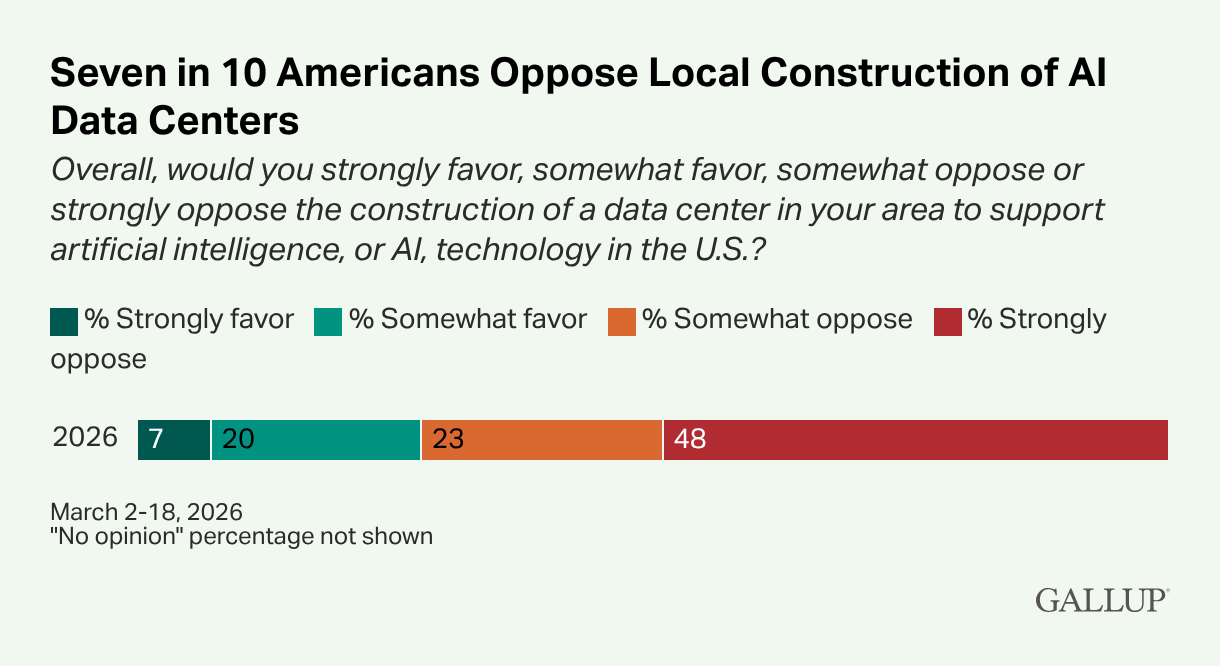
Data centers have, it’s safe to say, entered into the mainstream discourse, and most people don’t want them. Some numbers. About 70% of Americans oppose data centers coming to their towns, according to a Gallup poll, which reveals that this resistance moves across political lines. As for the reasons for the widespread opposition, there are many. But half of the respondents mention the strains on local resources, such as excessive water and energy use. The cost of electricity is another big concern.
Developers have not done themselves many favors, both in their rhetoric and in terms of their siting decisions. Many projects begin with nondisclosure agreements, then obfuscate when the public asks legitimate questions. Then there is where data centers are looking to build. A new Guardian analysis finds “about two-thirds of upcoming datacenters, which typically require a large amount of water to operate, are set to be built in places that have been among the driest in the country over the past year.”
Data centers require water for cooling, and that use, like many water uses, depends a lot on the local context. For one, water consumption can vary depending on cooling technology, decisions about energy use, and seasonal temperatures. In the aggregate, it’s true that data centers make up a much smaller water demand than agriculture.
But whether or not we have enough total water nationally to meet the total projected data center demand is obscures the fact that these issues play out on the local level, affecting infrastructure and the distribution of water at the local level. It’s similar to other types of industrial development (e.g., a power plant, a mine, a bottling facility).
So what is driving the concern, the more than 100 moratoriums, and water’s role in it? Local issues and contexts. Consider a sampling of voices from recent stories:
From NPR on Project Jupiter in New Mexico: "Being that we're in a drought, and then to allow a project like this to use that much water," Estrada says, "the fear is that we're going to run out, not only for us that live here but the farmers."
From Grist on Project Stratos in Utah on the urban heat-island and the Great Salt Lake: “What happens if you deposit that much energy continuously into a topography like this?” Davies wondered. “Right at the north end of the Great Salt Lake, a watershed that’s in collapse. A high-desert environment? A valley?”
From the Nevada Current on data centers in an over-allocated groundwater basin: “I think the question to this board is ‘how many acre feet as a board member would you be willing to give up of Pahrump’s water to a data center’,” said Lach. “Data centers can work in certain parts of the country, I just don’t see why when you have our water problem, why Basin 162 would be a place to do it.”
Like many water stories, it’s about the water, yes. But the intensity of the data-center backlash and high levels of engagement (in Utah, residents filed ~4,000 water protests against a high-profile project) also reflects much deeper issues about our economy.
It’s a reminder that water decisions are not only about water but are often are a lens through which we discuss larger questions, with social and political dimensions about who gets access to public resources, who bears negative costs, who reaps benefits, and how changes in water use affect tax bases, land use, and the trajectory of communities.
In some cases, companies have pledged to fund water projects and invest in needed upgrades in water. Some companies have bought existing water water rights so as not to add to water overuse, maybe even reduce it. Yet, in this movement of water and in these changes to land use, there remain many concerns. Out-of-state, profit-driven companies answer to whom? Boards that don’t live in the community? AI demand?
“You can’t drink data.” AI is moving faster than our ability to grapple with it socially and politically, and this story is about that too, just reflected through the lens of water, which in the West, is often shaped by booms and busts. “I keep trying to give them the benefit of the doubt, but this has all the hallmarks of an out-of-state megaproject with little concern for the local community,” said an ecologist with Grow the Flow, a group formed to save the Great Salt Lake and has raised concerns over Project Stratos.
Reading these stories, and seeing how communities were discussing these data center projects reminded me of interviewing sources for stories about mining. Similarly, you had faraway companies who made decisions about water that directly strained local resources. There were concerns about the cycles of booms and busts (What if mineral prices drop? What if the AI bubble bursts?). There were concerns about accountability and a lack of transparency. Concerns about the distribution of benefits and costs? Concerns about whether what is offered and embedded in our tax codes or regulatory policies was fair. Some of the companies were responsive to these concerns, offering significant Community Benefit Agreements. Some companies were less responsive.
At times, these projects also confused what seem to be an ossified politics, producing coalitions that brought together groups traditionally unaligned on other issues. It was never about water use in the aggregate (mines, in total, also do not consume as much water as agriculture), but about the specific local impacts, which could be extensive.
There’s a lot to unpack here. But for now, I will end with an excerpt from essay on AI, water and much more, by the dean of California water chroniclers, Mark Arax, who makes these parallels explicit, drawing a connection between AI and the legacy of mineral extraction, an export of the Golden State that has never really gone away:
Hydraulic mining, the state’s first invention sold to the world, had blasted out an immense crater in the Sierra Nevada, a desecration that let loose a torrent of environmental ruin. In a landmark decision, a judge shut down the mining industry in 1884. The crater, a symbol of California creation and destruction, was declared a state historic park.
But the fever of gold mining did not pass.
All around me, from inland to coast, the fire of extraction still burns. I have spent more than half my life chronicling the exploitations of California, so I know delirium to be a condition of the land. It took up residence in the body of the infant state and went on to spawn further extractions – a piling-on of audacities – so that one unthinkable taking gave rise to an even more unthinkable taking, and on and on through the generations.
Now, the Golden state has spun itself into a new and more menacing age of plunder: the mining of water and the mining of our minds.
What I’m reading:
Colorado River states have an expensive plan to live with less water. “The secretary requested a sort of wish list from those states, and they returned a wide-ranging collection of more than 80 projects with ballpark cost estimates that totaled in the tens of billions of dollars. The list, which was obtained by KJZZ, outlines more than $25 billion of potential spending in Arizona alone.” (KJZZ)
U.S. homes show three-decade decline in indoor water use: “Between 1999, when the first residential end-use study was released, to the third edition, which was published last week, indoor water use dropped by 43 percent. The tightening of indoor water use has allowed cities to grow despite mounting concerns about water availability, especially in the western states.” (Circle of Blue)
Letting a river act like a river: “For river ecosystems to survive dry times, they need their floods — and big, messy floodplains. In a case study recently published in Hydrological Processes, co-authors Ellen Soles, Martha Cooper and Laurel Saito demonstrate how channels formed during high flows on the Gila River connect native riparian vegetation to groundwater.” (Reasons to Be Cheerful)
The comeback of salmon: “Along its 85-mile course, [Putah Creek] is imprisoned behind dams, siphoned off by ditches, squeezed between artificially straightened and hardened banks. Although it lacked salmon for decades, in 2025 more than 2,000 chinook returned to spawn — an improbable triumph that reflects both human-led restoration and the resilience of the fish themselves.” (HCN)
Archetypes could accelerate agricultural adaptation to less snowpack: “… the “trillion-dollar question” isn’t how to adapt but, rather, where existing strategies may make the most—and fastest—difference to offset projected losses. Answering this question requires an approach that matches strategies to the contexts where they are more likely to succeed—one that treats basins as neither uniform nor unique.” (EOS)
Trump’s pick for Reclamation commissioner: “Aubrey Bettencourt, a Western water and agriculture expert, is listed as principal deputy commissioner for the bureau on Interior Secretary Doug Burgum’s most recent order delegating leadership authorities. The order also taps her to perform the duties of the commissioner. (E&E News)
One to keep watching — Tribe with senior Eel River water rights shut out of White House meeting: “Federal agriculture and interior officials convened a meeting Monday at the White House with PG&E and a Southern California water district over the future of the Eel River — and the tribe with senior water rights on that river was not in the room.” (Mendocino Voice)
A few life updates:
A dispatch from bookland: The last couple of months have been very productive for getting closer to completing the manuscript of my Great Basin/Nevada water book, which is still in the works and will hopefully be out by the end of next year.
As many warned me, by far the hardest part has been the necessary cutting. The good news is I’ve save the materials, and hopefully I can use some of it as fodder for future writing or research. Continuing to chip away on it over the next few months, and I’m excited to share more about the process (and the book!) soon.
What’s next: The big news in my life is that I graduated last week with my M.S. from UC Davis and I’ll be continuing my academic journey as a PhD student at UC Berkeley in the fall, focusing on groundwater policy. I’m thrilled to get started with this new chapter, building directly on my reporting work this past decade.
All the best, and I’ll write soon. Until the next dispatch, stay safe and healthy,
Daniel
The amount of water used for data centers pales in comparison to the water used to grow cattle feed under the blistering desert summer sun in places like the Imperial, San Joaquin, and Colorado River Valleys. Why isn't using a precious resource like this for farming that is ill out of place in the deserts not part of the discussion? We could move those feed farms to the Midwest, replacing the now useless and inefficient corn ethanol croplands.
Congrats on the MS!
Congrats on graduation/heading to Berkeley and all the best with writing the book. (I am slogging along with you!)